
Direct Answer
Yes, a smart home increases property value. Smart-featured properties always command a price premium over comparable units without smart home features, and they usually sell or lease faster. The price premium ranges from 3% to 5%, depending on quality, installation, and the market.
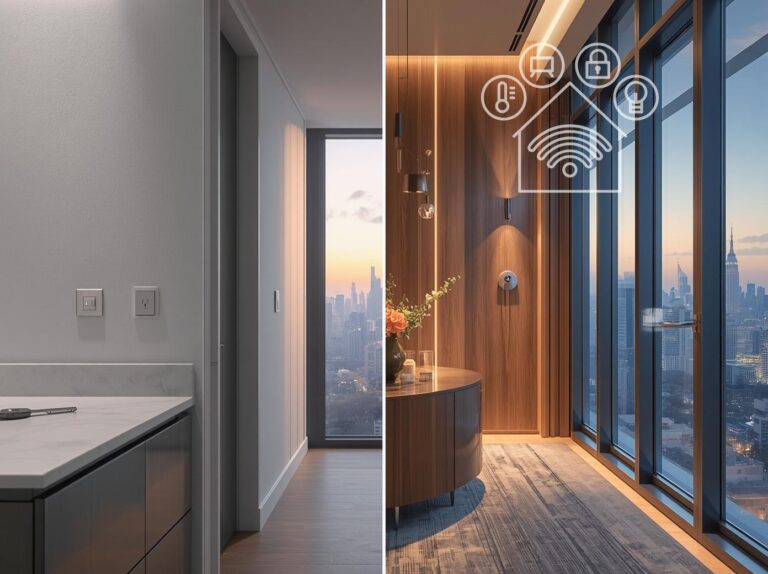
Imagine you’re a homebuyer who walks into two identical condo units. Same floor, same view, same price.
One unit has a standard lock and a light switch. Another unit lets you unlock the door from your phone, monitors who enters the building, and adjusts the air conditioning before you get home.
Which one sells first? Your answer must be the latter. And that single decision is at the heart of a question property developers and managers ask constantly: Does a smart home increase property value?
It’s not a trick question, and the answer has real implications for how developers price their launches and how property managers justify smart upgrades to homebuyers.
Not every smart feature has the same impact. Some drive measurable premiums and faster sales. Others look impressive in a brochure and add little to your property’s overall value.
This guide, ‘How does a smart home increase property value?’ breaks down exactly what the data shows, which features buyers in Malaysia actually respond to, and what separates a smart home investment that pays off from one that quietly erodes ROI after handover.
Why integrated systems beat scattered devices
Direct Answer
An integrated smart home system adds more value than a collection of separate devices, because homebuyers pay for infrastructure they can rely on rather than gadgets they have to manage.
There’s a big difference between a property with a smart home system and a property with smart gadgets.
Here’s an example. A property unit with a smart video doorbell from one brand, a thermostat from another, and multiple smart bulbs from a third brand isn’t exactly a smart home. In fact, the system involves three apps and three failure points, and the devices do not communicate with each other.
On the other hand, a property unit that relies on a centralized platform appears different. The smart home system consists of one app, one login, one point of support, and features that collaborate and work together.
For instance, the lights and air conditioners turn on instantly, as soon as a homeowner opens the door and says ‘I’m home’. The security system easily detects when the unit is empty. Energy monitoring covers the entire unit, allowing homeowners to monitor energy usage.
According to JCHS research from Harvard University, consumers value smart-home devices that work together, with 62% of consumers in a GfK study saying they wanted their smart-home devices to communicate with each other, rather than working separately.
Meanwhile, the Malaysian Communications and Multimedia Commission’s 2021 survey found that 32.6% of respondents considered home control an important or extremely important element of a smart home, while 66.6% gave the same response for home surveillance
The connected home automation system directly impacts property units. We suggest specifying a single platform across the project, with an open standard beneath it so future smart devices can join and drive higher revenue and ROI. Meanwhile, the connected system also frees you from maintaining four ecosystems in one building at once, which is costly.
The layers you can't retrofit cheaply
Direct Answer
The layers that cannot be retrofitted include the cables, a network backbone, mesh Wi-Fi coverage, central hub placement, sufficient DB points, and wiring at every smart switch location.
The components people can’t retrofit include:
- Structured cabling
- A network backbone
- Mesh Wi-Fi coverage that reaches every corner (including the car park, lobby, and service yard)
- Central hub placement with ventilation and power
- Sufficient DB points
- Wiring at every smart switch location.
None of the components mentioned are visible in a property show unit. However, all the components determine what the property can support over the next 10 to 15 years.
Thus, planning earlier is highly recommended.
Here is the difference. If you specify the home automation at the construction stage, the backbone adds a modest amount to the build cost, and every future upgrade only requires swapping smart devices.
However, Retrofitting later without specifying the system in advance means opening walls, patching ceilings and, disturbing an occupied unit. The cost difference is between an upgrade happening and an upgrade being abandoned.
For a modern homebuyer, a wired unit costs less and takes less time when adding a new smart feature. Conversely, a property unit that isn’t wired leads to the need for contractors and a management office application.
That’s the part worth considering and paying a premium for.
Practical checklist for you as a property developer or manager:
- Cat6 or better to every likely device location, terminated and labeled
- Wi-Fi access point provisions rather than relying on a single router
- Neutral wire at all switch positions
- A dedicated, ventilated location for the hub or gateway with power and network
- Conduit runs with pull strings for future additions
- Documented as-built cabling drawings handed over with the unit
how Does a Smart Home Increase Property Value? Here's the direct answer.
Smart homes increase property value by improving buyer appeal, supporting higher asking prices, and reducing operational costs that affect long-term yields.
The key is prioritizing features that solve real problems, not tech for tech’s sake.
The question isn’t really whether smart homes add value. At this point, the evidence is clear that they do. The more useful question for property developers is, “Which smart features deliver the best return, and where do projects go wrong?”
If ‘smart home’ sounds complicated, read ‘what is smart home automation‘ to understand more about the technology that continues to evolve.
What the Data Says: Smart Homes and Property Valuation
Direct Answer
The layers that cannot be retrofitted include the cables, a network backbone, mesh Wi-Fi coverage, central hub placement, sufficient DB points, and wiring at every smart switch location.
The numbers are compelling and increasingly relevant to the Malaysian market.
- Properties with integrated smart home systems are shown 3–10% premium over comparable non-smart units, depending on the depth of integration and local market conditions.
- Smart-featured units sell or lease faster than standard alternatives. In competitive launches, this is especially valuable; stronger early booking rates reduce carrying costs and improve cash flow timing.
- In the rental market, smart features can justify meaningfully higher monthly rates, particularly in condominiums, serviced apartments, SOHO, and co-living segments where tenant expectations are higher.
In Malaysia specifically, PropTech adoption is accelerating across the Klang Valley, Penang, and Johor Bahru corridors.
>>Visit the residential projects we contributed our smart solutions to.
Mid-to-high-end buyers, particularly younger owner-occupiers and investors, are increasingly treating smart access and home automation not as premium extras but as baseline expectations.
The market is shifting. Developments that get ahead of this curve are better positioned to differentiate; those that don’t risk looking dated at launch.
The Features That Actually Drive Value
Direct Answer
Smart access control and integrated security consistently carry the most weight with buyers. Smart lighting, motorised curtains, and energy monitoring provide strong support. Voice control and smart appliances differentiate a property without driving the decision on their own.
Smart access control. Smart door locks with multiple unlock methods are the highest-impact category and the technology homebuyers interact with when they reach the front door.
Multiple unlock methods matter because every household has distinct needs. For example, A temporary PIN for a cleaner, an RFID card for the elderly parent, a fingerprint for daily use, and a mobile app linked to the smart lock for the owner who’s away from home. For investor buyers, the ability to issue and terminate a tenant’s access remotely without changing a physical smart lock changes how the team manages.
Integrated security. CCTV with smart features, such as remote viewing, real-time alerts, motion detection, and event recording. Homes with advanced smart security are reported to be approximately three times less likely to be broken into by intruders, and security is the second thing a homebuyer rarely asks about in a gated community.
Tier two: strong supporting features
Smart lighting and motorized curtains. Homeowners use both devices daily after move-in; features include scene control, scheduling, and daylight response. Smart lighting also consumes about half the energy of conventional lighting, helping homeowners save on energy costs.
Energy monitoring is more relevant in Malaysia because the local energy isn’t for heating. Air conditioning accounts for the biggest share of a Malaysian household’s electricity bill. The 2 features of energy monitoring consist of circuit-level monitoring and smart control. Circuit-level monitoring shows which units are running and for how long, giving homeowners actionable insights. Smart air-conditioning control can also reduce household consumption by 10% to 15%.
Tier three: differentiators
Voice control rarely drives smart home value on its own. Instead, the voice control system is a robust tool for demonstrations during unit viewings. According to KNX’s observation, introducing a homebuyer voice control system affects their purchase decision, even when the buyer wouldn’t have listed voice control as a necessary requirement.
Smart appliances are treated as a perceived luxury. Compatibility with the main home automation system matters more than the individual appliance.
If you’re looking for a smart solution for your project units, consider the Raizo smart home automation system as the best option for your property.
Other features that carry weight with buyers.
Water leak detection with automatic shut-off is one of the few smart home features most insurers respond to directly, because the system helps prevent losses they have to pay. A sensor under the water heater shuts off the main valve immediately when it detects water, preventing a burst pipe from becoming a ceiling replacement. This detection is especially useful in stratified buildings, where a leak from one unit often affects others.
Smart smoke and gas detection is widely expected in Malaysian smart homes. For example, remote alerts offer more value than conventional detectors. The homeowner receives an instant alert on their mobile phone when the system detects a gas leak or a kitchen fire in an empty unit.
Smart irrigation and outdoor lighting are relevant for landed property. Weather-responsive irrigation eliminates water waste, and scheduled or motion-triggered lighting enhances perimeter security.
Solar with energy monitoring is more readily recognized by valuers than other smart technologies. This is because solar has a measurable impact on running costs, which fits into what a valuation can rationalize.
Aging-in-place features are mostly absent from a genuine differentiator and the market conversation for the right project. Some of the features include:
- Keyless entry eliminates the issue of an elderly resident searching for keys or losing them.
- Voice control eliminates the need to reach for and operate physical switches.
- Motion-activated night lighting lowers the risk of the elderly falling on the way to the bathroom.
- Remote monitoring allows homeowners to check on their senior parents who live alone at home, even when they’re away.
The Features That Actually Drive Value
Direct Answer
Smart access control and integrated security consistently carry the most weight with buyers. Smart lighting, motorised curtains, and energy monitoring provide strong support. Voice control and smart appliances differentiate a property without driving the decision on their own.
The smart home conversation is ultimately a business case. Here’s how to think about it.
Cost vs. Value Uplift
A well-specified smart access and automation stack typically represents a relatively modest percentage of total development cost, yet it can support a meaningfully higher average selling price and reduce the time units sit unsold.
The calculation isn’t just about the unit price premium. Faster sales velocity reduces financing costs, improves cash flow, and creates momentum during the launch phase, outcomes that have real financial weight, especially in developments with over 100 units.
Differentiation in a Competitive Market
In property markets with a supply overhang in Malaysia, smart features provide a tangible point of difference.
When two developments are similarly priced and located, the one with a credible smart home proposition tends to win.
Smart homes also generate stronger marketing content that appeals to modern homebuyers: showroom walkthroughs and lifestyle demonstrations all perform well digitally and support both organic and paid marketing campaigns.
What Developers Often Get Wrong
- Over-investing in consumer gadgets and under-investing in infrastructure. Homebuyers prioritize access control with enhanced convenience and security. They tend to care less about smart appliances.
- Choosing proprietary systems that lock residents into a single vendor, making upgrades difficult, and creating post-handover friction.
- Briefing sales teams too late. If the smart home proposition isn’t built into the buyer journey from the start, from initial inquiry through showroom visit, much of its perceived value is lost.
Who's buying, and why the Smart Home Feature changes the specification
Direct Answer
Around 43% of Gen Z homebuyers rate smart features as very important, compared with roughly 15% of Baby Boomers. Younger buyers want convenience and customization, elder buyers want safety and resale value, and investor buyers want lower tenant turnover costs. One standard package can’t serve all three well.
Various homebuyers have different needs and expectations. There’s a huge gap: a single standard package will overserve one specific group and underserve another.
A Statista survey states that about 43% of Gen Z buyers rate smart features as very important. The figure is closer to 15% for Baby Boomers. From there, you can identify what each age group genuinely wants.
The following are the preferences from different age groups:
Younger buyers want customization and convenience. They look for smart features such as app control, scenes, voice control, and the flexibility to add new devices or features later. In other words, they’re comfortable around the latest technology, but have no patience for things that are old and don’t work.
Buyers in their middle years prefer household management and comfort. For instance, Air conditioning and lighting scheduling, and remote access for helpers and family members.
Older buyers prioritize safety and security. Elderly homebuyers are the most forward-thinking group when it comes to a home’s resale value. They’re also the group for whom aging-in-place features matter most.
Investor buyers, who account for a large share of Malaysian condominium purchases, care only about how home automation technology affects tenant turnover costs.
Conclusively, the practical implication for a developer is simple. You shouldn’t apply the same smart home specification to every targeted group, including A young-family township, a city-fringe investor product, and a retirement-oriented development. Market smart features differently for each group.
Running costs, energy, and insurance
Direct Answer
Around 43% of Gen Z homebuyers rate smart features as very important, compared with roughly 15% of Baby Boomers. Younger buyers want convenience and customization, elder buyers want safety and resale value, and investor buyers want lower tenant turnover costs. One standard package can’t serve all three well.
Air conditioning is where homeowners usually spend the most on a Malaysian household’s electricity bill. Smart home control here means scheduling based on occupancy, geofencing so the unit’s electricity switches off when the owner leaves, temperature-limit features that stop a unit from running at 17 degrees all night, and current monitoring that lets the homeowner see which room draws the most power.
The numbers that translate:
- Smart lighting consumes approximately 50% less energy than traditional lighting
- Whole-of-household smart control normally lowers energy use by 10% to 15%
For insurance, some overseas insurers offer premium discounts for leak detection and monitored security systems. However, this is patchy and inconsistently applied in Malaysia.
Hence, homeowners should ask their insurers directly rather than making assumptions, and the developer should also confirm whether their panel insurer recognizes the building’s security specification.
From our point of view, energy savings alone rarely justify a smart home package on payback maths. Instead, what energy savings do is support the value argument alongside other factors, such as convenience and resale.
When smart technology hurts your property value
Direct Answer
Smart technology reduces property value when the system is tied to the previous owner’s account, partly broken, locked to a discontinued brand, or too complex for the next occupant to operate. Around 46% of buyers cite maintenance cost as a concern and 40% cite obsolescence. In some markets non-smart comparables have sold higher.
Here’s an honest fact: smart home automation technology doesn’t always add value. In fact, the technology subtracts value if it’s done badly.
The buyer research from the smart home company, Vinvint, assigns hard numbers on the hesitation:
Concern | Share of buyers |
|---|---|
Privacy | 60% |
Cybersecurity | 56% |
Dependence on the network | 49% |
Installation and maintenance cost | 46% |
Device reliability | 41% |
Becoming obsolete | 40% |
Too complex to operate | 21% |
These aren’t irrational. Each one maps onto a real failure mode:
The home automation system is connected to someone’s account. When the previous homeowner’s email is still the admin, nobody has the account password, and the supplier has disappeared, the homebuyer needs to take up hardware they can’t control and a locksmith bill.
Half of the home automation system is broken. Two sensors go offline, a mobile app that the vendor hasn’t updated in a few years, and a central hub that requires a reset no one knows how to operate. A viewing where the home automation demonstration fails causes more damage than having no system in place at all.
Nobody can operate the home automation system. The automation system that requires manual operation is the system the next occupant or tenant will feel tired of and eventually stop using. Complexity reads as a maintenance liability, not sophistication.
The home automation system is locked to a brand that’s moved on. Proprietary systems age badly. The entire smart home installation becomes decoration when the supplier discontinues the line or closes the cloud service.
The abandonment problem. Issues like wall-mounted panels for a smart home automation system that no longer works, wiring for smart home devices that were never installed, and a mobile app icon nobody taps signal neglect and buyers’ price neglect.
Non-smart comparables have sold for more than smart devices on the market. As a result, factors such as whether the home automation works smoothly, transfers cleanly, and can be supported are what make the difference.
The takeaway for a developer or a homeowner may sound uncomfortable but useful. If you can’t commit to a home automation system that will need constant servicing in ten to fifteen years, with a supplier who’ll still be answering the phone, it’s better to wire the property properly and install less.
The Property Manager's Perspective: Operational Value Beyond the Sale
Direct Answer
Smart home systems reduce management workload, lower complaint volumes, and improve resident retention, all of which protect and grow asset value over time.
The value of a smart home doesn’t stop at handover. For property managers, it often begins there.
Access Management Efficiency
Smart access control dramatically reduces the time and cost involved in managing lost access cards, credential updates, and move-in and move-out processes.
What previously required a trip to the management office can now be handled remotely on a centralized property management dashboard.
Fewer manual processes mean lower staffing requirements and faster resolution times for disputes, both of which contribute directly to significant operational cost savings.
Fewer Resident Complaints
Access-related complaints are among the most common issues in high-rise residential management.
Lost, duplicated physical keys or cards, broken readers, and slow credential resets create unnecessary friction between residents and your management teams.
Smart access systems address this at the source. When access is easier and more reliable, the number of complaints reduces and resident satisfaction increases.
The Link Between Resident Experience and Property Value
Ongoing resident satisfaction affects review ratings, referral rates, and rental demand, all of which influence long-term yields and asset performance.
A property with a great reputation for smooth, responsive management retains tenants longer, attracts quality replacements faster, and sustains stronger rental rates.
Over a 5–10 year period, the smart home system contributes meaningfully to total asset value.
Risks and Pitfalls: What Can Reduce Smart Home Value
Direct Answer
Poorly chosen or poorly supported smart home systems, poor after-sales support, and integration failure can actively reduce property value and increase management burden. The risks are manageable, but you need to plan the system properly.
Smart homes are an asset when done well. Done poorly, they become a liability. Here are the main risk areas to plan around.
System Obsolescence
Smart home systems without upgrades are unreliable and can cause technical issues later.
If the technology becomes unsupported or the suppliers cease operations, residents are left with systems that don’t work and management teams that can’t fix them.
Open, integration-friendly smart home systems with clear, consistent upgrades are a significantly safer investment than closed-ecosystem alternatives, even if the initial hardware cost is higher.
Poor After-Sales Support
This is the biggest fear among property developments: the supplier disappears after handover.
A smart home system that generates complaints because it’s unreliable, unsupported, or hard to use actively hurts perceived property value and adds to management workload rather than reducing it.
Supplier selection needs to include an honest evaluation of support SLAs, local presence, and spare parts availability.
Integration Failures
Smart home systems that don’t connect to the property management platform (PMS) create operational headaches.
Before committing to any system, it’s worth verifying integration compatibility with existing platforms and requiring a live demonstration, not just a specification sheet.
5 Questions to Ask Any Smart Home Supplier Before Signing
- What are your response time SLAs for support after handover?
- Do you have spare parts available locally and 24/7 after-sales support?
- Who owns the resident data, and where is it stored?
- Is your system compatible with our current property management system?
- Does your system still get updates for the next 3–5 years?
- Can you provide references from completed Malaysian residential projects of a similar scale?
How to Maximise Smart Home Value: A Practical Framework
Direct Answer
Focus on access and security first, choose open systems, build the smart home narrative into your marketing and management processes, and evaluate suppliers on post-handover support from day one.
For Property Developers
- Start with access and security. These offer the highest buyer ROI and form the foundation that everything else builds on.
- Choose open, integration-friendly systems. Supplier lock-in is a risk to both the development and its future residents.
- Build the smart home narrative into marketing from day one. not as a fancy display in the brochure, but as a main part of the homebuyer journey, from digital ads through the showroom experience.
- Evaluate suppliers on post-handover support, not just hardware specs. The specification meeting is just the beginning of the relationship.
For Property Managers (Existing Properties)
- Audit what’s already in place. Identify the gaps creating the most complaints and the highest management time cost.
- Prioritise smart access upgrades. This offers operational relief and improves resident satisfaction.
- Building the internal business case using operational data, complaint volumes, staff hours spent on access management, and resident satisfaction scores makes the ROI case solid.
- Plan for phased implementation. A full smart home fitout isn’t required to capture meaningful value gains. A well-executed Phase 1 focused on access and security often delivers a positive impact.
Conclusion
Smart home technology isn’t a “nice-to-have ” anymore. For properties operating in Malaysia’s increasingly competitive market, the real question is no longer, “Does a smart home increase property value?” It’s, “How much value are you leaving on the table by waiting?”
The evidence is clear. Smart-featured properties command stronger prices, sell faster, and deliver ongoing operational advantages that compound over time. But the returns aren’t automatic.
The lucrative returns go to residential developments that invest in the right features, choose systems built to last, and back them up with reliable after-sales support.
The projects that get this right aren’t just adding technology; they’re building a better resident experience, a stronger management operation, and a more defensible market position.
If you’re ready to explore a smart home system that sets your property apart, our team can walk you through the right fit for your project; visit our smart home solutions page.