
Direct Answer
Here are the 7 ways home automation helps homeowners save money on energy bills?
- Air-conditioning scheduling and setpoint control
- Switching the air conditioning off from anywhere
- Smart lighting that switches off automatically
- Installing a smart thermostat that stops the guessing
- Shifting heavy loads into TNB off-peak hours
- Staying under TNB’s rebate thresholds
- Noticing energy waste before it appears on the bill
Have your residents complained about how high the electricity bills are?
That can be frustrating, especially when the resident is trying to save on electricity costs, but doing everything manually is challenging.
So homebuyers may ask one important question about the smart home package in your showroom: Does the property unit include an energy-saving smart home system?
The savings belong to somewhere else entirely, and the arithmetic runs on TNB’s 2026 tariff.
Throughout this guide, we’ll go through the seven ways home automation helps homeowners save money on energy bills, what’s worth it for each, and what you need to specify before handover so your residents can actually use them.
If you want to know more about automation before heading into this article, start with the guide about ‘what is smart home automation‘.
Where the money actually is in a Malaysian home?
Direct answer:
Air conditioning consumes the most electricity. A measured study of homes in Kajang and Putrajaya showed that air conditioners accounted for 11.5 kWh per day of the total weekday household consumption of 21.9 kWh. That is roughly 52.5% of the bill from a single appliance category.
Above all, everything else is smaller by a wide margin. The same study measured refrigeration at 2.5 kWh per day, lighting at 0.4 kWh per day, and water heating at 0.32 kWh per day.
That ranking presents where automation proves its value. A smart home system that controls air conditioning well and lighting badly still saves money. A system that does the opposite does not.
But still, a proper smart home system should do its job well in optimizing the smart devices your residents own.
Load | Measured daily use | Does a smart home system control it? | Realistic savings on that load |
Air conditioning | 11.5 kWh | Yes, schedule, temperature, occupancy cutoff | 6–10% (ACEEE) |
Lighting | 0.4 kWh | Yes, motion sensors, timers, scenes | 7–27%, less standby draw (ACEEE) |
Refrigeration | 2.5 kWh | No, and cutting power to a fridge spoils food | 0% |
Water heating | 0.32 kWh | No | 0% |
Plug-in appliances | Varies | No, sockets stay on the normal circuit | 0% |
Sources: Journal of Engineering Science and Technology (Taylor’s University), 2017, measured study of Kajang and Putrajaya households; American Council for an Energy-Efficient Economy, Report A1801, “Energy Impacts of Smart Home Technologies.”
Quotable: In a Malaysian home, air conditioning and lighting are the only two loads the Raizo smart home system fully controls. Air conditioning accounts for roughly 15 times as much as lighting on the bill.
1. Air-conditioning scheduling and setpoint control
Direct answer:
Automated air-conditioning control enhances cooling savings by 6% to 10%, according to ACEEE’s review of smart thermostat field studies, and air conditioning is the biggest load in a Malaysian home.
As the weather gets hotter, air conditioning has become an essential appliance for most Malaysian households. That’s why it’s hard to ignore the savings features and practices.
The following are the three habits the smart home system enforces without anyone remembering:
- Setpoints stop drifting. A schedule keeps the temperature at 24°C overnight rather than 18°C, which is where most of a home’s waste comes from.
- The savings survive a bad week. Some homeowners may forget to switch off their home’s air conditioning every morning. A schedule turns off the air-con in the morning during a public holiday, and on the day the family rushes out late.
Apply 8% to a 11.5 kWh daily air-conditioning load, and a household removes roughly 15 kWh a month.
2. Switching the air conditioning off from anywhere
Direct answer:
Homeowners can use the mobile app connected to the smart home system to switch the air conditioner on and off from outside the home, so the aircon stops costing money the moment the resident remembers.
A smart schedule covers the predictable hours. The RaizoSmart app covers everything the schedule cannot predict.
- The afternoon that changes. Homeowners encounter many unexpected situations, such as a work meeting that runs late, the family staying out for dinner, or a weekend trip that gets extended. The homeowner only needs to tap on his phone from the car park to switch off the cooling.
- The room nobody went back into. The living rooms and study rooms get cooled and then forgotten more often than any other rooms in the house.
Residents who prefer seamless voice control can control the air conditioner through Google Home or Amazon Alexa. Both voice and app reach the same system..
3. Smart lighting that switches off automatically
Direct answer:
Smart lighting saves 7% to 27% of lighting energy, but ACEEE found that lamp efficacy falls by an average of 38% when network standby draw is included, so the net savings are smaller than most suppliers claim.
Lighting accounts for a small portion of the energy load in a Malaysian home. Automated lighting is worth specifying for residents’ convenience and safety, with energy savings as a secondary benefit.
But it’s still worth noting that smart LED bulbs consume 90% less energy than traditional incandescent bulbs.
Meanwhile, smart home automation handles the rest of the tasks: motion sensors turn lights off in empty rooms, daylight sensors dim fixtures when natural light is sufficient, and scheduled routines ensure nothing stays on overnight.
You should be honest in your sales material. If you tell your homebuyer that the smart bulbs will significantly reduce the bill, but they see a surprisingly higher bill 2 months later, they will stop believing everything else in the brochure you provided.
Where lighting automation does pay: bathrooms, storerooms, corridors, and stairwells, where lights burn for hours because nobody walks past the switch again.
4. Installing a smart thermostat that stop the guessing
Direct answer:
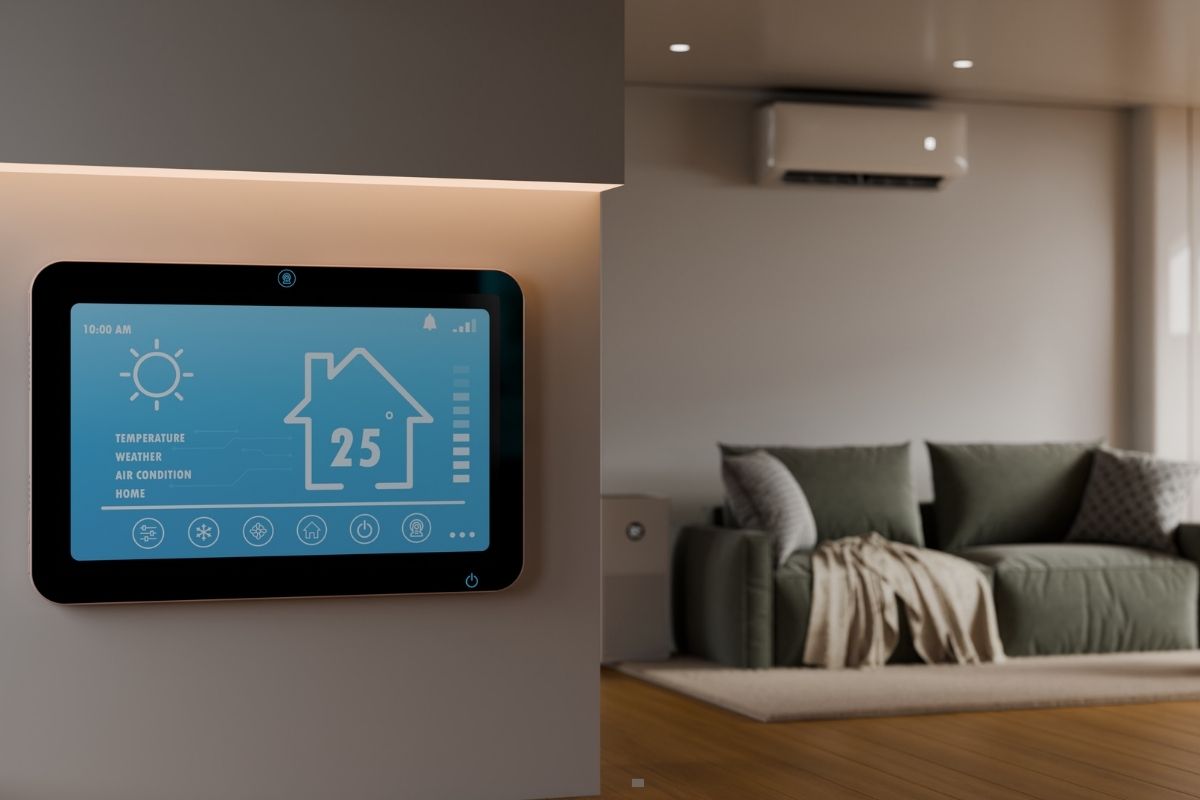
A smart thermostat sets the air conditioner to a fixed temperature and changes it depending on the time of day. ENERGY STAR estimates that smart thermostats save about 8% on heating and cooling costs each year, and cooling is the largest load in a Malaysian home.
Heating and cooling consume more energy than any other system in a home. More than half of total household energy goes to HVAC, according to the U.S. Energy Information Administration.
Hence, the smart thermostat plays its role by reducing HVAC waste by learning occupancy patterns, adjusting temperature based on time of day, and using geofencing to detect when residents leave or return.
Here is how the thermostat actually works:
- One temperature, held. The bedroom stays at 24°C overnight instead of dropping to 18°C. Every degree lower than the optimal temperature costs more.
- Different settings for different hours. The bedroom is cooler at 11 pm, when people are asleep, and it gets warmer by 5 am, when it’s already cold, without anyone noticing the difference.
What is 8% worth in a Malaysian home?
The ENERGY STAR figure is based on US homes, where most of the savings come from heating. Applied to cooling alone, on the 6.06 kWh a day that Malaysian air conditioners were measured drawing:
Per month | |
Air-conditioning use | ~182 kWh |
Removed at 8% | ~15 kWh |
5. Shifting heavy loads into TNB off-peak hours
Direct answer:
Malaysian households on TNB’s domestic Time of Use tariff pay 28.52 sen/kWh during peak hours and 24.43 sen/kWh during off-peak hours, and smart home automation automatically shifts air-conditioning o the cheaper window.
The domestic ToU schedule, effective from 1 July 2025, works like this:
Period | Hours | Rate (≤1,500 kWh/month) |
|---|---|---|
Peak | 2:00 pm–10:00 pm, Monday to Friday | 28.52 sen/kWh |
Off-peak | 10:00 pm–2:00 pm weekdays | 24.43 sen/kWh |
Off-peak | All day Saturday, Sunday, and public holidays | 24.43 sen/kWh |
Two conditions your residents need to know:
- A compatible meter is required. TNB verifies the meter types on application. Households apply through the MyTNB app, by email, or at a Kedai Tenaga, with a one-time RM10 stamp duty.
- Time of Use (ToU) only pays when the current load is actually running. A household that uses the washing machine at 4 pm, regardless of the tariff, pays more on ToU than on the standard tariff. This is why it’s worth switching to home automation.
6. Staying under TNB's rebate thresholds
Direct answer:
TNB’s Energy Efficiency Incentive offers a per-kilowatt-hour rebate that decreases as monthly usage rises, so a household that falls below a threshold earns a larger rebate on every unit it consumes that month.
This is the energy-saving fact and the reason energy visibility inside the property unit is more important in Malaysia than in other markets.
Under the RP4 structure, effective 1 July 2025, a domestic bill combines an energy charge of 27.03 sen/kWh (for consumption below 1,500 kWh per month), a capacity charge of 4.55 sen/kWh, and a network charge of 12.85 sen/kWh.
A retail charge of RM10 per month is waived for consumption of up to 600 kWh. The EEI rebate is then deducted from the total.
What crossing one threshold is worth
Take a household using 610 kWh a month that cuts 15 kWh, about 2.5% of usage:
610 kWh | 595 kWh | |
|---|---|---|
Energy + capacity + network at 44.43 sen/kWh | RM271.02 | RM264.36 |
EEI rebate | −7.5 sen/kWh = −RM45.75 | −9.0 sen/kWh = −RM53.55 |
Retail charge | +RM10.00 | Waived |
Total | RM235.27 | RM210.81 |
Cutting 15 kWh reduces the bill by RM24.46. At the base rate alone, 15 kWh is worth RM6.67. The rebate step and the retail-charge waiver do the rest.
Figures exclude AFA, which is capped at ±3 sen/kWh and reviewed monthly, as well as the 1.6% KWTBB levy. Verify both against the bill current at the publication date.
Quotable: In Malaysia, a household that reduces its monthly consumption by 2.5% at the right threshold can cut more than 10% of its bill, because TNB’s Energy Efficiency Incentive rebate applies to the whole month’s usage rather than only to the units saved.
7. Noticing energy waste before it appears on the bill
Direct answer:
Home automation signals a load running in the back when there’s no one at home, which is how Malaysian households find an air conditioner that is still on, a heater left on, or an empty unit still being cooled for a period.
It can be bothersome when units stay empty, while the home equipment continues running behind when the resident is not at home, going on a trip, or moving out.
An away mode that switches off non-essential circuits after a homeowner asks the AI assistant to turn off the electricity or simply taps the smart app eliminates waste. The saving is whatever home device was running, for however long nobody realized.
What does this mean for your property units?
Direct answer:
None of the seven savings depend on your management office. The resident owns and operates the smart home system themselves from the day they first move in.
What the resident acquires decides whether the seven savings above are available to them. Specify these:
- A smart thermostat on every air conditioner. Without the largest load, the smart home system saves only a few ringgit a month. Hardware cost per point is low, and installation is simple, which is what makes air conditioning the highest-return item in the package.
- In-unit energy visibility. Threshold behavior needs the meter to display so the resident can monitor and adjust before the bill reaches his home.
- Motion sensors on the lighting. Bathrooms, store rooms, corridors and stairwells.
- An away scene the resident triggers. One action, whether is through tapping on the mobile app or saying out a the prompt, turn off all the electricity.
In the meantime, you can discover how your residents can futureproof their homes.
Explore the full Raizo smart home system that helps your residents reduce their TNB electricity bills, so they feel satisfied living in your property unit.
Conclusion
Home automation is not just about making a property fancier and more convenient. Instead, the home automation system helps your residents lower unnecessary energy use and keep their monthly TNB bills under control, so they won’t be surprised by the huge total amount.
The biggest opportunity is air conditioning, followed by practical controls such as automated lighting, away modes, energy monitoring, and load scheduling.
For you, as a property developer, this means a well-planned smart home brochure and package that allow your residents to see the real benefits they’ll get after handover: greater control over their home’s energy consumption and potentially lower running costs.
If you’re planning a new residential project or upgrading your existing property units, explore how the Raizo smart home automation system can help your residents manage their energy use more efficiently.